
This article was translated from the original human-written German version. While we strive for accuracy, we cannot guarantee it is error-free. We recommend consulting the German original for the most precise information. This content is for informational purposes only and does not constitute financial or legal advice. Always consult with a qualified professional before making insurance or financial decisions.
Doctor's Bills in Private Health Insurance: A Fact Check on the Reimbursement Principle
The process of a doctor's visit in Germany differs fundamentally depending on whether one is privately or statutorily insured. A frequently asked question concerns the payment of doctor's bills in Private Health Insurance (PKV): Do privately insured individuals really always have to pay in advance?
This article examines the different billing principles in Statutory Health Insurance (GKV) and PKV. We explain the underlying mechanisms and show what patients can expect in practice in both systems.
Fundamentals of German Health Insurance Systems
Statutory Health Insurance (GKV): GKV, which covers around 90% of the population, is based on the principle of solidarity. Contributions are income-dependent, while benefits are based on medical need. In a pay-as-you-go system, current income is used to finance current healthcare costs.
Private Health Insurance (PKV): PKV operates according to the equivalence principle. Benefits are contractually defined in the chosen tariff, and contributions are based on individual risk (age at entry, health status). A significant difference is the creation of old-age reserves to stabilize contributions in old age.
The Doctor's Visit: How Billing Works
The way the costs of a doctor's visit are billed is the central difference.
For GKV Insured: The Service Principle
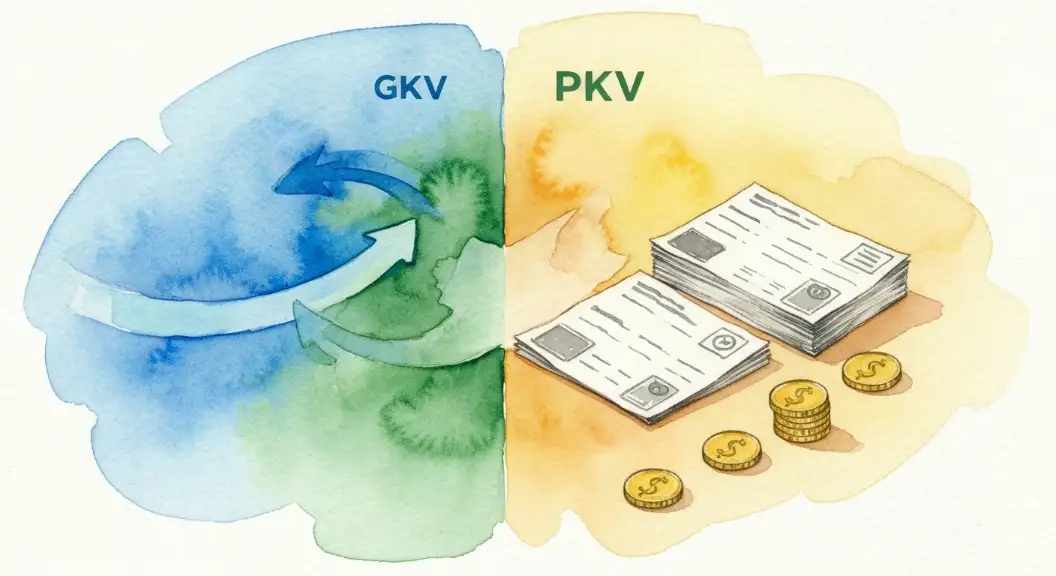
GKV insured individuals present their electronic health card (eGK) at every doctor's visit. This card allows for direct billing of treatment costs between the doctor's office and the health insurance fund. The patient does not have to pay in advance for treatments included in the catalog of services.
The scope of services is comprehensively defined in the Social Code Book (SGB V) and is subject to the principle of economic efficiency. The Joint Federal Committee (G-BA) decides on the inclusion of new medical procedures in the service catalog.
For PKV Insured: The Reimbursement Principle
In PKV, the reimbursement principle applies. The insured person is the contracting partner of the doctor and initially receives an invoice from them. Basically, the insured person pays this invoice themselves and then submits it to their insurance company for reimbursement according to the tariff.
Important Practical Arrangements:
For outpatient treatments (e.g., with a general practitioner or specialist), advance payment by the patient is the norm.
For high costs, especially for inpatient hospital stays, direct billing between the hospital and private insurance is common practice. Many insured individuals use a hospital card or sign an assignment of claim for this purpose, so they do not have to pay five-figure sums in advance.
Medical fees are regulated by the Fee Schedule for Physicians (GOÄ) or Dentists (GOZ), which allows for billing based on individual services.
Consequences of Different Billing Methods
Co-payments in GKV: Statutory co-payments are foreseen for many services, for example, for medications (usually 5 to 10 Euros), medical aids and appliances, and hospital stays (10 Euros per day, for a maximum of 28 days per year). The annual burden of co-payments is limited to 2% of gross income (1% for chronically ill patients).
Deductibles and Waiting Periods in PKV: In PKV, there are generally no co-payments for individual services. Instead, annual deductibles may be agreed upon in the tariff to reduce the monthly premium. In addition, waiting periods for certain service areas (often 3 months general, 8 months for dental treatment or childbirth) may apply upon conclusion of the contract.
The Role of the Insurance Card
The GKV card is a direct billing key and the symbol of the service principle.
In PKV, the card primarily serves for identification. The billing process reflects the reimbursement principle and the direct contractual relationship between the patient and the doctor.
Conclusion
The question of whether PKV insured individuals have to pay their doctor's bills in advance can be answered in a nuanced way:
Yes, for outpatient treatments, the reimbursement principle with advance payment is the rule. However, for high bills, especially in the hospital, direct billing between the clinic and insurance is common practice to relieve the financial burden on the insured.
Both systems have specific characteristics. The choice depends on personal factors such as income, marital status, and individual healthcare needs. A thorough understanding of the respective billing processes helps to optimally manage one's own healthcare.