
This article was translated from the original human-written German version. While we strive for accuracy, we cannot guarantee it is error-free. We recommend consulting the German original for the most precise information. This content is for informational purposes only and does not constitute financial or legal advice. Always consult with a qualified professional before making insurance or financial decisions.
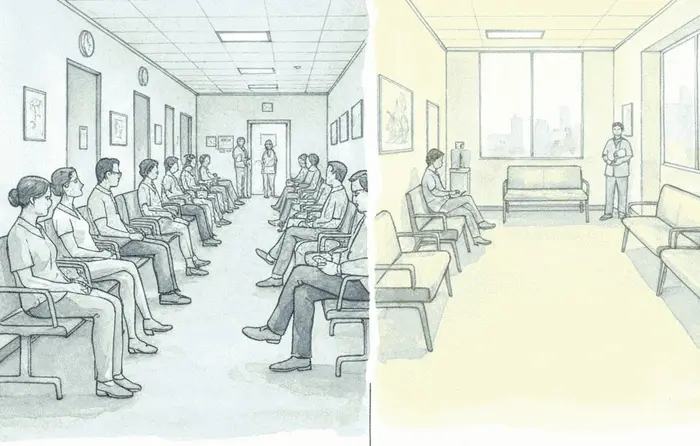
Waiting times in healthcare: A look at systemic differences
Introduction
In the German healthcare system, the faster appointment scheduling for privately insured patients (PKV) compared to statutory health insurance (GKV) is a key issue. The reasons for this primarily lie in the different remuneration structures of the two insurance systems. This article analyzes the fundamental differences between GKV and PKV and explains how the respective billing models influence appointment scheduling in practice.
Basics: The Systems in Comparison
To understand appointment scheduling, it is important to know the fundamental principles of statutory health insurance (GKV) and private health insurance (PKV). Both systems meet the requirements of mandatory insurance in Germany, but they differ fundamentally.
Statutory Health Insurance (GKV)
GKV is based on the principle of solidarity. This means that benefits are based on need, while contributions are based on income. GKV is organized as a pay-as-you-go system: the income of the younger generation directly finances the benefits for the older and sick. Age reserves are not formed. The scope of benefits is legally defined in SGB V as "adequate, appropriate, and economical care" and can be adjusted by the legislator.
Private Health Insurance (PKV)
PKV is based on the principle of equivalence, where the premium corresponds to the insured risk. Premiums are based on age at entry, health status, and chosen tariff. A key feature is the formation of age reserves. A portion of the premiums is saved to dampen premium development in old age (around €328 billion across the industry at the end of 2023). The contractually agreed benefits are guaranteed and cannot be unilaterally reduced.
In-depth: Billing Models and Their Impact on Appointment Scheduling
The different principles lead to significant differences in the remuneration of doctors and thus also in appointment scheduling.
Budgeting in GKV
The remuneration for the treatment of GKV patients is regulated by budgets. A standard treatment volume (RLV) is set for each practice. Services that exceed this budget are often reimbursed at a reduced rate or not at all. This can result in doctors receiving lower or no cost-covering remuneration for certain services towards the end of a quarter. This mechanism can influence the incentives for treating GKV patients and appointment availability.
Remuneration and Performance Principle in PKV
Billing for privately insured patients is not subject to budgeting. Fees are set in the Scale of Fees for Doctors (GOÄ) or for dentists (GOZ). Doctors can adjust the multiplier depending on the effort involved. This system is not tied to quarterly budgets. Financially, privately insured patients generate additional revenue in the healthcare system (approx. €45 billion in 2023), contributing to the mixed financing of practices and hospitals.
Differences in Benefits for New Procedures and Additional Services
1. Access to New Treatment Methods
In GKV, new methods must first go through the Joint Federal Committee (G-BA), which checks their benefit and cost-effectiveness. This process can take time. In PKV, costs for medically necessary procedures can be reimbursed even if they are not yet listed in the GKV catalog, provided the tariff does not exclude them.
2. Comparison of Selected Service Areas
Eyeglasses/Contact Lenses: GKV only covers in exceptional cases for adults. PKV covers depending on the tariff.
Dental Prostheses: GKV provides a diagnosis-related fixed subsidy for standard care. PKV reimburses according to the contractually agreed percentage, including for implants.
Alternative Treatment Methods: GKV generally does not cover costs for alternative practitioners. In PKV, this can be agreed upon in the tariff.
Hospital Stay: GKV entitlement includes multi-bed rooms and ward doctors. Special services (e.g., chief physician, single room) can be insured in PKV.
Preventive Examinations: PKV can cover examinations beyond the statutory GKV programs.
International Health Insurance: Worldwide coverage is often included in PKV tariffs, while GKV coverage is primarily limited to the EU.
Decision Criteria for Choosing an Insurance System
Scope of Benefits: Legally defined (GKV) vs. contractually agreed and individually designed (PKV).
Premium Calculation and Family Insurance: Income-dependent with premium-free family insurance (GKV) vs. risk-based with an individual premium for each person (PKV).
Access Requirements: Open to almost everyone (GKV) vs. tied to professional group/income and with a health check (PKV).
Premium Development in Old Age: Pay-as-you-go system (GKV) vs. funded system with age reserves (PKV).
Switching Options: Switching from PKV back to GKV is rarely possible from the age of 55. Within PKV, there is a right to switch tariffs (§ 204 VVG).
Summary
The different speed in appointment scheduling can largely be attributed to the different remuneration systems. Budgeting in GKV can limit doctors' fees, while budget-independent billing according to GOÄ/GOZ in PKV creates financial incentives that can affect appointment scheduling.
The additional revenue generated by private patients is part of the mixed financing in the German healthcare system. Choosing the right system is an individual decision that requires careful consideration of benefits, costs, and personal life circumstances.