
This article was translated from the original human-written German version. While we strive for accuracy, we cannot guarantee it is error-free. We recommend consulting the German original for the most precise information. This content is for informational purposes only and does not constitute financial or legal advice. Always consult with a qualified professional before making insurance or financial decisions.
Hospital Services: A System Comparison of Statutory (GKV) and Private (PKV) Health Insurance
A hospital stay is an exceptional situation for most people, where the quality of medical care takes center stage. But what services are policyholders entitled to? The claims differ fundamentally depending on the health insurance system – statutory (GKV) and private (PKV).
This article highlights the differences in inpatient care, analyzes the regulations for choosing doctors and hospitals, as well as accommodation, and shows what options are available to shape one's own coverage.
1. GKV vs. PKV: The Fundamentals of Service Promises
The way hospital services are defined is rooted in the core principles of the insurance systems.
The GKV: Statutorily Defined Scope of Services
The scope of services for GKV is uniformly regulated for all policyholders in the Social Code Book V (SGB V). According to § 12 SGB V, services must be sufficient, appropriate, and economical. This ensures comprehensive statutory coverage. The service catalog can be adapted by the legislator to new circumstances.
The PKV: Individual Coverage Through Contractually Agreed Services
In PKV, policyholders determine the scope of their coverage by choosing their individual plan. The services once agreed upon are contractually fixed and cannot be unilaterally reduced by the insurer. Doctors can use all medically necessary and recognized procedures when treating private patients.
2. Hospital Services in Detail: The Key Differences
The system differences are particularly evident in inpatient care.
Accommodation
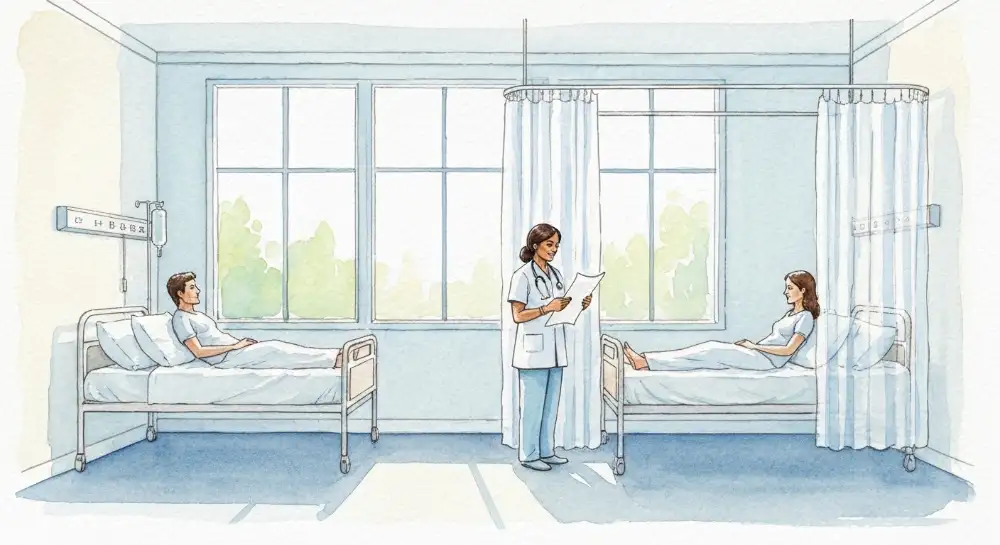
Services in GKV: Policyholders are entitled to accommodation in a multi-bed room.
Services in PKV (plan-dependent): Accommodation in a one or two-bed room can be contractually agreed upon, allowing for more peace and privacy.
Medical Treatment
Services in GKV: Treatment is provided by the on-duty specialist of the ward.
Services in PKV (plan-dependent): Private medical treatment (often referred to as chief physician treatment) can be agreed upon. This allows for personal treatment by the clinic's billing-authorized physicians, such as the chief physician or senior consultants.
Choice of Hospital
Services in GKV: There is free choice among all contracted hospitals approved by the statutory health insurance funds.
Services in PKV (plan-dependent): Insurance coverage may include free choice of hospital, including purely private clinics.
3. Supplementary Options for GKV Policyholders
Statutory policyholders can individually expand their coverage through private supplementary hospital insurance. Typical components of such plans include:
Accommodation in a one or two-bed room
Private medical treatment or chief physician treatment
Free choice of hospital
A supplementary daily hospital allowance
These plans allow statutory insurance coverage to be supplemented according to personal preferences.
4. Recommendations for Action: What Does This Mean for Your Decision?
Choosing the right level of hospital coverage is a personal decision.
Checklist for Your Hospital Coverage:
Analyze your current coverage: Do you know your contractual or statutory entitlement regarding accommodation and choice of doctor?
Define your personal requirements: What importance do you place on privacy, treatment by an attending physician, or free choice of clinic?
Examine your options:
As a GKV policyholder: Evaluate whether supplementary hospital insurance is advisable to cover your needs.
As a PKV applicant: Choose a plan that meets your requirements for inpatient care.
FAQ: Frequently Asked Questions
Do I have to make co-payments in the hospital?
In GKV, a co-payment of €10 per day applies for a maximum of 28 days per year. In PKV, depending on the plan, there may be no deductible or an agreed-upon deductible, but no statutory daily co-payment.
What is the difference with private clinics?
Private clinics often have different personnel or technical equipment and may specialize in certain fields. Access is usually possible for private patients, self-payers, or GKV policyholders with appropriate supplementary insurance.
Summary
GKV Services: In the hospital, statutory policyholders are entitled to treatment in a multi-bed room by the on-duty doctor in a contracted hospital.
PKV Services: Depending on the plan, private policyholders can contractually secure one or two-bed rooms, chief physician treatment, and the free choice of hospitals, including private ones.
Consistency: In PKV, agreed-upon services are contractually fixed, whereas the GKV service catalog can be adjusted by the legislator.
Supplementation: Statutory policyholders can adapt their coverage to their individual wishes through private supplementary hospital insurance.
The decision about inpatient insurance coverage involves weighing the statutorily defined coverage of GKV against the individualizable, contractually fixed services available in PKV or through supplementary plans.