
This article was translated from the original human-written German version. While we strive for accuracy, we cannot guarantee it is error-free. We recommend consulting the German original for the most precise information. This content is for informational purposes only and does not constitute financial or legal advice. Always consult with a qualified professional before making insurance or financial decisions.
Premium Refund in Private Health Insurance: A Neutral Analysis
Choosing health insurance is an important financial decision. One aspect of interest to privately insured individuals or those considering a switch is the possibility of a premium refund (BRE) in Private Health Insurance (PKV). But what does it entail and under what conditions is it granted? This article illuminates how BRE works in PKV, compares it with similar mechanisms in Statutory Health Insurance (GKV), and analyzes the factors relevant for its assessment.
Fundamentals of Financing Systems: GKV and PKV
To contextualize the premium refund, understanding the systemic differences is helpful:
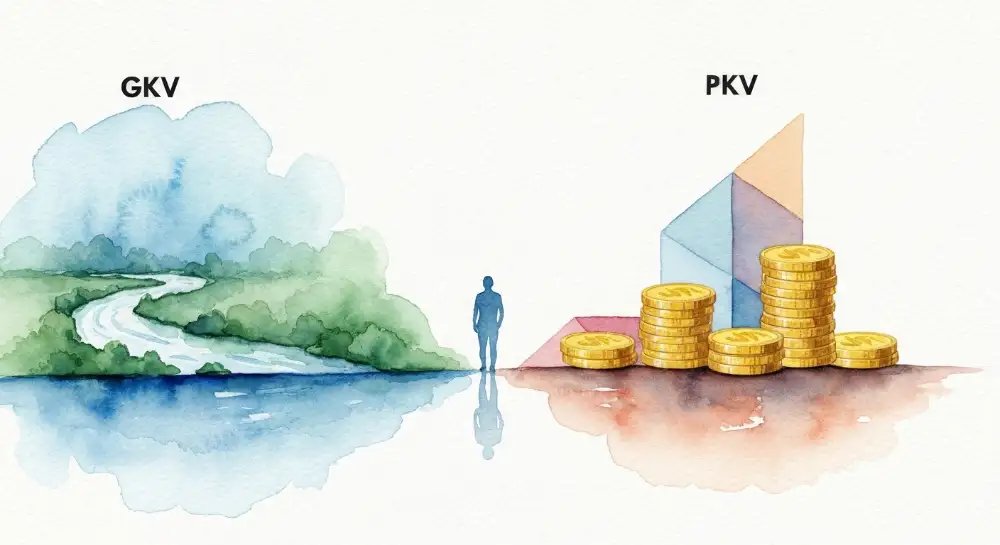
Statutory Health Insurance (GKV): The GKV, which insures approximately 90% of the population, is based on the principle of solidarity. Contributions are income-dependent and finance the ongoing healthcare expenses of all members through a pay-as-you-go system. No individual old-age provisions are formed.
Private Health Insurance (PKV): The PKV follows the principle of equivalence. Contributions are based on individual risk and the chosen tariff. In the capital-funded system, a portion of the premium is saved as old-age provisions to stabilize contributions in old age.
The Principle of Premium Refund in PKV
The premium refund is a mechanism through which private health insurers distribute generated surpluses to their policyholders. It is a voluntary and non-guaranteed benefit from the insurer, depending on its business success.
Surpluses can arise if the benefit expenditures of an insured collective are lower than calculated or if capital investments yield good returns. BRE typically takes two forms:
Success-dependent refund: A direct participation of policyholders in the economic success of the company.
Flat-rate payment for claims-free periods: Policyholders who do not submit any invoices within a calendar year receive a flat-rate refund, which can often amount to several monthly premiums.
This creates an incentive for policyholders to pay smaller medical bills themselves, so as not to lose their claim to the refund. The decision to submit an invoice or bear the cost oneself thus becomes an individual commercial consideration.
Practical Aspects of Billing in PKV
PKV operates on the principle of reimbursement: the insured person receives an invoice, pays it, and then submits it to their insurance company for reimbursement according to the tariff. Unlike GKV, where legally mandated co-payments apply to many services, such co-payments are uncommon in PKV. Instead, tariffs may include deductibles, which also encourage cost-conscious behavior.
Comparison to GKV and the Question of Economic Efficiency
In GKV, there is no premium refund directly linked to an individual's claims-free status. However, some health insurance funds offer bonus programs or optional tariffs that reward health-conscious behavior (e.g., prevention, sports) with premiums or subsidies. These are generally lower than a potential BRE in PKV.
Whether foregoing the submission of small invoices in favor of a BRE in PKV is worthwhile depends on the individual situation:
Health status: Individuals who rarely require medical services benefit most. An unexpected, major illness can quickly negate the financial advantage of a year.
Amount of BRE vs. Invoices: The decision is a simple calculation: Is the guaranteed refund for claims-free status higher than the sum of the invoices you pay yourself?
Tariff with deductible: A tariff with a deductible can reduce monthly premiums. Invoices up to the amount of the deductible are borne by oneself anyway, making the claim to a BRE more likely.
It is crucial to understand that BRE is an annually re-evaluated, non-guaranteed benefit.
Conclusion and Recommendations
The premium refund in PKV is a potential financial advantage that can reward cost-conscious behavior. However, it should not be the primary criterion for choosing health insurance.
For your decision and to make optimal use of your insurance coverage:
Check your tariff conditions: Inform yourself precisely about the prerequisites, the type (success-dependent vs. flat-rate), and the amount of possible BRE in your tariff.
Analyze your behavior: Realistically estimate your annual "smaller" healthcare costs to weigh whether foregoing their reimbursement is worthwhile.
Consider the overall package: More important than a potential BRE are the contractually guaranteed scope of services, the long-term stability of contributions through old-age provisions, and the general tariff conditions.
Seek professional advice: Independent advice can help you find a tariff whose overall concept – including the regulations for BRE – suits your life situation.